Beyond the Broadcast: Our Bold New Season Begins. Watch Now ->
Beyond the Broadcast: Our Bold New Season Begins. Watch Now ->

During Passover and the Feast of Unleavened Bread, no food containing leaven, or yeast (called chametz (KHAH-mets) by the Jewish people), is to be consumed. Exodus 12:15 tells us “...you shall remove leaven from your houses; for whoever eats anything leavened from the first day until the seventh day, that person shall be cut off from Israel.” Prior to the Passover Seder (SAY-der), many Jewish homes conduct an extensive “chametz hunt” with the entire family, searching for any leaven and even cleaning cupboards with a feather.
Yeshua (Jesus) as well as Jewish sages teach that the bad things we do are like leaven. Just as we prepare our homes for Passover, it is good to search within ourselves for the leaven of sin.
Paul made reference to this when he addressed the Believers in Corinth and made the same analogy. He admonished them to keep the feast of Passover, but to remember that they are “a new batch of dough” without leaven – sin – because Yeshua, their Passover lamb had been sacrificed for them. Therefore they should keep the feast in a way that is fitting and honoring to the Lord not just outwardly, but with a pure heart and the “unleavened bread” matzah of sincerity and truth (1 Cor. 5:6-8).
So we too should prepare our hearts for the Feast of Passover, remembering the many generations of faithfulness and love of the mighty God we serve that will be recounted in this 3,500 year tapestry of remembrance.
A Passover Haggadah (HAH-gah-dah) will help you navigate through the elements of your Seder. It contains colorful commentary, Hebrew content, and interesting insights beyond the blessings and the “order of the service”:
The woman of the house will open the service by kindling the candles, from her right to left and reciting:
Four cups of wine are raised during the Seder for the four “I wills” – God’s promises from Seder cup Exodus 6:6-7: “Say, therefore, to the sons of Israel, ‘I am the Lord, and I will bring you out from under the yoke of the Egyptians. I will free you from being slaves to them, and I will redeem you with an outstretched arm and with mighty acts of judgment. I will take you as my own people, and I will be your God. Then you will know that I am the Lord your God, who brought you out from under the yoke of the Egyptians. ’ ”
The Blessing Over Wine or Grape Juice*
*This blessing is used for the 1st, 3rd & 4th cups. The 2nd cup, the Cup of Judgment is not partaken.
Twice during the Seder we wash our hands. This is a symbolic act of purification in imitation of the Priests who had to wash before offering the sacrifices. In John 13, we see that Yeshua even washed His Disciples’ feet at their Seder as a lesson in humility. Remember this lesson of love and humility as you help one another with the bowl and the towel.
Dip a sprig of parsley in the salt water, then recite:
Parsley dipped in saltwater reminds us that even the sweetness of life may be immersed in tears, and to thank God that through much suffering, He has made a people, a Nation, and sent His promised Messiah.
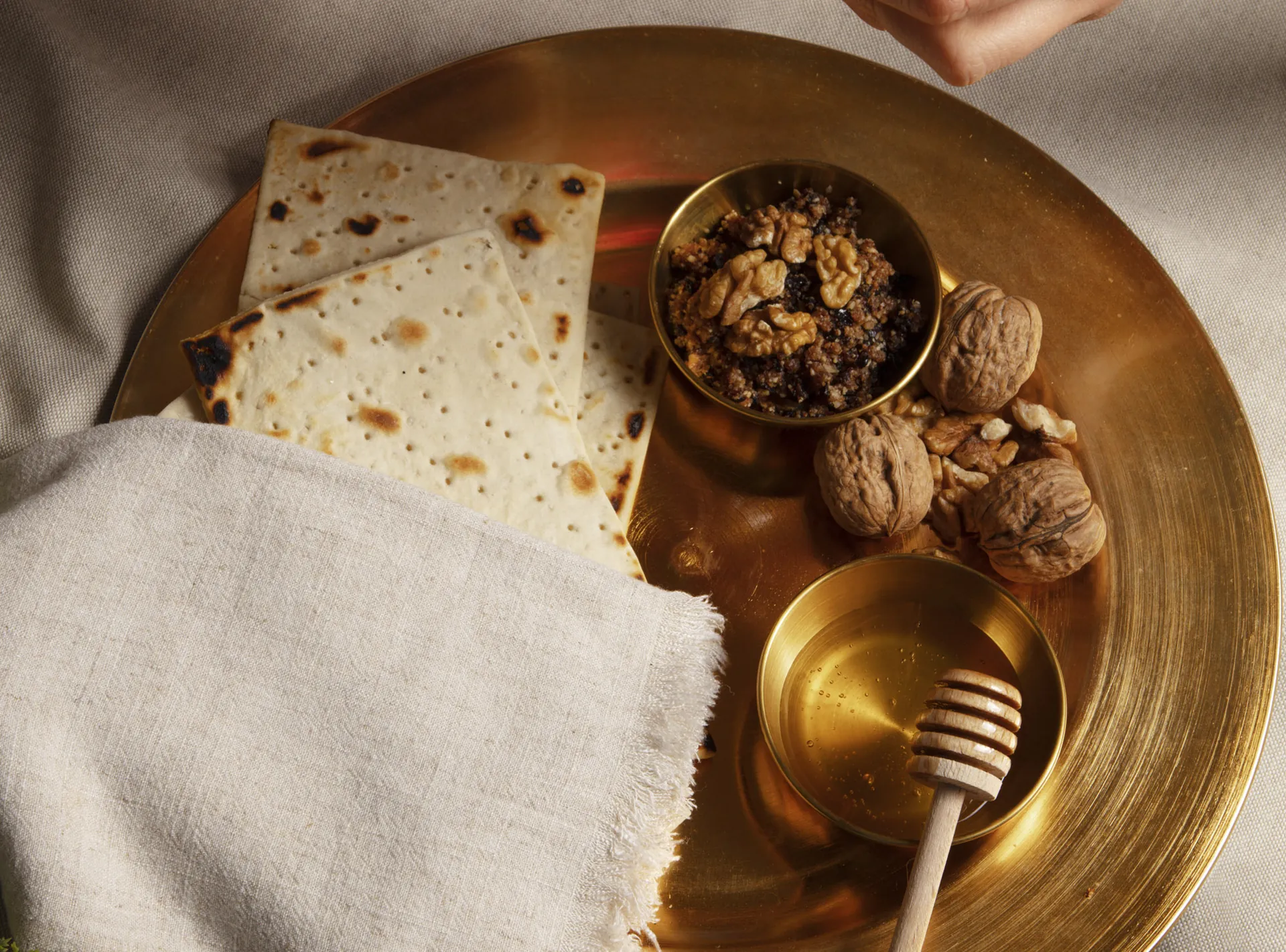
The Leader will take the middle matzah and break it, wrapping half in a linen napkin, and hide it to be found by a child at the end of the night and “ransomed” back. All guests share a piece of this portion called the “Afikomen,” a Greek word meaning “I came!”
Believers in Yeshua see an uncanny symbolism in this ritual. Matzah is picture of Yeshua also in that it is without leaven (sin) and pierced and striped. (Is. 53)
This begins the long interactive narrative. The central element is answering a child’s four questions, called the “Ma Nishtanah,” which is often sung in Hebrew. Why is this night different than all other nights?
It concludes with the Second Cup, the Cup of Judgment, with reciting the ten plagues of Egypt. As each plague is spoken, a drop of wine is removed from the glass by dipping a finger in and allowing a drop to fall on a plate, symbolizing our joy being diminished as we remember the terrible cost to Egyptians for Pharaoh’s disobedience.
Leader distributes the top matzah to all the guests.
Put a bit of horseradish on a piece of matzah, then recite:
The sweet apple mixture is scooped with the bitter herbs onto a piece of matzah. This is the “second dip.” We are reminded of Yeshua’s reference in John 13:26 to dipping the [unleavened] bread at His Last Supper.
Your Passover Seder will break for supper before concluding with the cup Yeshua lifted, the Cup of Redemption the Cup of the New Covenant ratified by His blood and still so much more! We hope this has enriched your understanding and encouraged you to incorporate this special celebration into your worship.