Beyond the Broadcast: Our Bold New Season Begins. Watch Now ->
Beyond the Broadcast: Our Bold New Season Begins. Watch Now ->

The Feast of Sukkot is one of the most unusual holidays God established for Israel to observe. It includes living in temporary structures, waving a bundle of vegetation, sacrifices and offerings, a holy assembly, rejoicing, and a day of Sabbath rest. Sukkot is a seven-day “appointed time,” but, surprisingly, God also includes instructions for the eighth day. (See Leviticus 23:39–44, Deuteronomy 16:13–16, and Numbers 29:12–40.)
Ultimately, Sukkot is about remembering that the Israelites dwelled in temporary tents during their 40-year journey through the wilderness on the way to the Promised Land and how God’s presence was with them the whole time.
Sukkot: Living in “Booths” for Seven Days
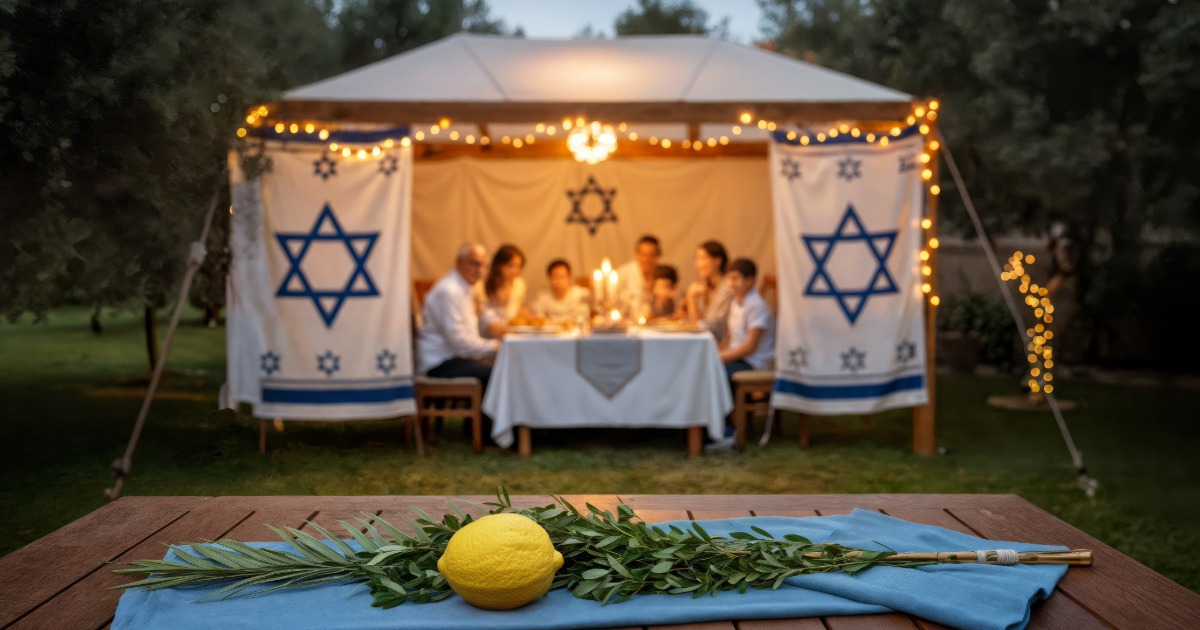
God commanded that the Feast of Sukkot last seven days, during which Jewish people are to live in “booths” or tents called sukkot in Hebrew. The singular of sukkot is sukkah. These temporary structures have a loosely constructed roof, often made of natural greenery, through which one can see the stars at night. This reminds us of God’s promise to make Abraham a great nation with descendants as numerous as the stars.
The First Day of Sukkot
The first day of Sukkot includes a holy assembly, a Sabbath rest in which no work is done, and a particular observance called “the waving of the lulav.” This lulav is a hand-held bundle of four species of biblically prescribed vegetation which is ceremonially waved in the air.
Sukkot Sacrifices
The Bible commanded many sacrifices for each of the seven days of Sukkot. These included bulls, goats, and lambs along with grain and wine offerings. The bull sacrifices are extraordinary in that the number decreased from 13 on the first day to seven on the seventh day, totaling 70 bulls over the seven days.
Sukkot Rejoicing
Sukkot is the only one of God’s “appointed times” for which He commanded the Jewish people to rejoice. It may seem odd – the idea of commanding joy – but it shows us that joy is a choice much like gratitude. We can experience it apart from our circumstances when we focus on the right things, namely the ways God has blessed us.
One of the most significant blessings God has given us is His presence, which is what Sukkot is all about.
The Assembly of the Eighth Day: Stay a Little Longer
God commanded that Sukkot last seven days, but then He added something else: instructions for the day after Sukkot ended. Day 8 included another gathering, additional sacrifices and offerings, and a day of rest.
This eighth day is called Shemini Atzeret. Shemini means “eighth” in Hebrew, and Atzeret means “assembly,” or “gathering.” It also carries the meaning of “to stop, hold back, or tarry.”
Because Sukkot is about dwelling with God, Jewish sages have long understood this eighth day as God’s invitation to stay back and tarry a little longer with Him.
Presence and Joy
The sukkah is a special place of feasting, fellowship, and enjoying the company of those you share the space with. It’s a place of meals and laughter and lively discussions that, over the hours, winds down into quiet, deep conversations.
And then, as you lie down for sleep, inner solitude settles over you as you gaze through the leafy roof to the stars above. As others around you fall asleep, it’s just you and God – together in a quiet space for joy over the gift of His presence.
Why So Many Sacrifices at Sukkot?
During Sukkot’s seven days, 183 animals were to be sacrificed. Add another 10 required on the eighth day, and a total of 193 animals died to observe Sukkot during Temple times. Why was the pleasure of celebrating God’s presence tainted with so much death? Perhaps it was to show us the high cost of reconciling sinful humanity to the holy God.
To enable the sweet fellowship of God’s presence, our sin had to be dealt with. Here, Sukkot points us straight to Yeshua (Jesus), who willingly died as a once-and-for-all sacrifice to pay for our sin and bring us near to God.
Sukkot is about Dwelling with God
At Sukkot, God invites us to dwell with Him in a set-apart way reminiscent of Israel’s history in the wilderness with Him. He commands us to rejoice over His presence and provision.
The most astonishing thing to realize is that God delights when we spend time with Him – whether it’s an underlying awareness of His presence while with others or a direct communication during quiet times alone with Him.
As unfathomable as it is, God actually cherishes our company. In Shemini Atzeret, He even invites us to an extra day as if saying, “Don’t go. Stay with Me a little longer.”
Sukkot may be a special time to focus on the joy of God’s presence, but Shemini Atzeret's invitation brings home the fact that our presence with Him is precious to God. That’s something worth remembering and enjoying every day of the year.
…In Your presence is fullness of joy; at Your right hand are pleasures forevermore.
— Psalm 16:11 (NKJV)
Whoever dwells in the shelter of the Most High will rest in the shadow of the Almighty.
— Psalm 91:1 (NIV)
“As the Father has loved Me, I also have loved you. Abide in My love!”
— John 15:9 (TLV)



A biblical look at the why, what, when, and how of thankfulness.

Pray for two locally-led outreaches this month: Ethiopia's Beta Avraham congregation serving the Kechene Jewish community and Zimbabwe's first Lemba-run medical clinic.

Prayer points for the Jewish people during a week of mixed emotions: remembering the October 7 Hamas attack anniversary and celebrating Simchat Torah.
The seven-day Feast of Sukkot is one of the most unusual holidays God established for Israel to observe. In this article, we explain the various observances God commanded for Sukkot and the invitation He includes by adding instructions for an eighth day, which is known as Shemini Atzeret.